

Why You Keep Meeting Bots on Random Chat
You click “Start,” your screen loads, and… it’s a bot. You skip. Another bot. Skip. Another bot. At some point you start wondering if there are any real humans left, or if the entire internet has been replaced by scripts with suspiciously perfect lighting and zero personality.

Bots on random chat aren’t a “you problem.” They’re a predictable result of how these platforms work: instant access, huge traffic swings, weak identity checks, and an endless incentive for spammers to automate everything. The upside is you can usually reduce bot encounters a lot, sometimes dramatically, by understanding what attracts bots, what triggers them to target you, and how to change your setup so you land in more human-heavy traffic.
What counts as a “bot” on random chat
Not every weird interaction is a bot, but most people can feel it within seconds.
Scripted chat bots
These are the classic “Hi” → “Where are you from?” → “Add me on…” sequences that repeat like a broken record. They respond instantly, never acknowledge what you said, and steer the conversation toward a link, an app, or a social handle.
Scam operators pretending to be real
Sometimes there is a human behind the keyboard, but they’re following a script and running multiple chats at once. It feels bot-like because the goal isn’t conversation, it’s conversion.
Video loops and stolen streams
On video chat platforms, “bots” can be pre-recorded loops or stolen live streams. They don’t react naturally to your gestures or timing. You wave, they don’t match it. You change the topic, nothing changes.
Referral and affiliate spam
A lot of bots exist simply to push traffic to another site. It’s automated marketing disguised as random chat.
Why bots love random chat platforms so much
Random chat is basically the perfect playground for spam.

Zero friction, huge reach
Bots thrive where they can hit thousands of people quickly. Random chat platforms are designed for instant connection, which is great for real users but also ideal for automation.
Weak identity checks
Many random chat sites don’t require phone verification or strong sign-ins. That keeps things “fast and anonymous,” but it also makes it easier for bots to return after getting blocked.
It’s cheap to attack
A bot can run on a simple server, rotate through proxies, and spam endlessly. The cost is low, and even a tiny success rate can be profitable.
Moderation is hard at scale
Real-time moderation is expensive. Even platforms that care can struggle because bots evolve constantly, and detection systems often have to balance “blocking bots” with “not banning real users by mistake.”
The incentives: what bots are trying to get from you
Understanding the goal helps you spot patterns instantly.
Getting you to click a link
This is the big one. Links can lead to phishing pages, scam offers, fake dating pages, malware, or affiliate funnels.
Moving you off-platform
“Add me on Telegram,” “Snap?” “Instagram?” “WhatsApp?” Bots want to move you to a place where the platform can’t moderate or protect you.
Harvesting personal info
Sometimes the chat is designed to pull your age, location, phone number, or social handle. Even small info can be used for targeting or social engineering later.
Pushing paid content or fake “verification”
Another pattern is “verify to continue,” “pay to unlock,” or “confirm you’re real.” Anything that asks for payment or a card is a huge red flag.
Why you might be seeing more bots than other people
Two users can use the same site and have totally different experiences.
Your region or IP range might be targeted
Spammers often target certain countries, cities, or IP ranges because it’s easier to monetize traffic there, or because those ranges are known to be less aggressively moderated.
You’re connecting during high-bot hours
Bots run 24/7, but human traffic peaks at certain times. When human traffic is low, bots become a bigger percentage of what you meet. Late-night hours in some regions can feel bot-heavy.
You reconnect too fast
Rapid skipping can make you land in “low quality” pools or trip anti-spam systems in weird ways. Some platforms also backfill fast connections with anything available, which can include bot clusters.
Your setup looks “easy to farm”
This sounds odd, but some bots and spam networks prioritize users who appear more likely to click. That can be based on language, device type, or behavioral signals.
Common bot giveaways you can spot in 3 seconds
Bots are getting smarter, but they still have tells.
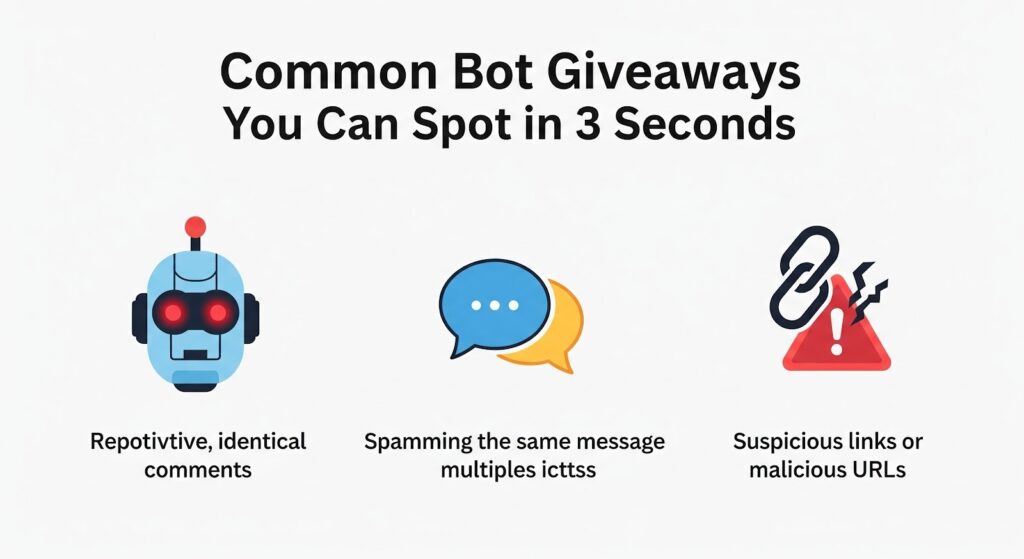
Instant replies with zero context
If you type something specific and the response ignores it completely, that’s a bot or scripted operator.
Repeated opener patterns
“Hi dear,” “Hey handsome,” “Where are you from?” over and over. Same rhythm, same timing.
Aggressive off-platform push
If they try to move you to another app within the first few lines, assume it’s spam.
Link drops or “search this username”
Any attempt to make you click, search, or scan something quickly is usually not a real conversation.
No natural reaction on video
You wave, they don’t respond to the timing. You cover the camera, the “person” keeps moving the same way. You speak, they don’t react.
How bot filters and moderation actually work
Most platforms use a mix of detection layers.
Rate limiting and behavior scoring
They look at how fast accounts connect, how often they repeat phrases, how many people they message per minute, and whether they trigger reports.
Fingerprint and device signals
Bots often run in automated environments. Platforms may detect unnatural browser fingerprints, headless sessions, or repeated device patterns.
Report-based suppression
User reports still matter. If enough people report a pattern, the platform can block it quickly, assuming the reporting system isn’t abused.
Trade-off: catching bots vs hurting real users
The stricter the system, the more false positives happen. That’s why many sites feel like they’re always slightly behind: they tighten rules, bots adapt, real users complain, rules loosen, repeat.
What you can do right now to meet fewer bots
These are practical steps that usually work across most random chat platforms.
Slow down your reconnect rhythm
If you’re skipping instantly for ten minutes straight, you’re basically speed-running the worst part of the platform. Try this instead:
- stay in a chat for a few seconds longer
- don’t hammer Next like a machine
- if you hit multiple bots in a row, pause for 30–60 seconds and restart cleanly
This sounds too simple, but it changes the patterns the platform sees and can move you out of “spam clusters.”
Change network if you can
Bots often concentrate around certain IP ranges and proxy pools.
- If you’re on Wi-Fi, try mobile data for a session
- If you’re on mobile data, try Wi-Fi
- Restarting your router can sometimes change your public IP (depends on ISP)
If your IP range is “dirty,” you’ll meet more garbage.
Avoid VPNs on random chat
VPN IP ranges are heavily abused by spammers. Even if you use a VPN for privacy, the reputation of that IP range can push you into bot-heavy pools or cause platforms to treat your sessions as suspicious.
If you’re bot-hunting, try a clean, non-VPN connection for a while.
Use platforms that actually invest in bot cleanup
Some sites are simply better at keeping bots down because they prioritize moderation and filtering.
If you want an option that’s often praised for removing spam and keeping things cleaner, try Freecam, people regularly note that Freecam is very good at cleaning bots and keeping the experience more human: freecam.chat.
Use interests/filters carefully
Interests can help, but they can also attract targeted spam if the interest is commonly monetized. Broad interests sometimes work better than ultra-specific ones.
Try interests like:
- “music”
- “movies”
- “gaming”
- “travel”
Instead of: - “dating”
- “snap”
- “onlyfans”
Those are basically bot magnets.
Keep your browser clean (extensions can make things worse)
Some extensions interfere with WebRTC or make your browser look unusual. If a platform sees “weird” signals, you can get routed oddly or face more spam.
Try one session with:
- no VPN
- minimal extensions
- a standard browser profile
If the bot rate drops, your setup was part of the issue.
The “bot loop” problem and how to break it
A frustrating pattern happens when you meet a bot, skip fast, meet another bot, skip faster, then get stuck in a loop.
Why it happens
Some platforms effectively have “queues” or pools. If bots are flooding a pool and you keep reconnecting instantly, you may keep getting matched into the same messy segment of traffic.
How to break it
- Close the tab/app
- Wait a minute
- Reopen
- Start again with a slower pace
- If possible, switch networks before restarting
This simple reset often changes your routing and reduces repeated bot hits.
If you’re on video chat: how to detect loops and fake streams
Video bots can be sneaky because they look “real” at a glance.
Ask for a simple real-time action
A real person can respond naturally. Try:
- “wave with your left hand”
- “hold up three fingers”
- “look to the side for a second”
If they don’t react at all, it’s likely a loop or stolen stream.
Watch for unnatural timing
Even humans can be awkward, but loops have patterns:
- repeated micro-movements
- identical gestures every 10–20 seconds
- no reaction to you speaking or moving
Don’t reward it with attention
Loops exist because they work on some people. If you suspect one, skip quickly and move on.
Safety: what not to do when you meet a bot
Bots want you to do something. Your job is to do the opposite.
Don’t click links
Even “harmless” links can lead to tracking, phishing, or worse.
Don’t share your social handles
If you want to keep chatting, keep it on-platform. Moving off-platform early is exactly what bots want.
Don’t share personal details
Location, age, workplace, school, phone number, anything that makes you identifiable is valuable to scammers.
Don’t argue with bots
It sounds funny, but it just wastes your time and gives them engagement signals if they’re being tracked.
Why platforms can’t “just remove all bots” overnight
It’s a cat-and-mouse game.
Bots evolve fast
The moment a platform blocks a pattern, spammers tweak phrasing, timing, IP rotation, and behavior. It’s constant adaptation.
Strong filters can hurt real users
If a platform tightens too much, real people get blocked or banned by mistake. That creates user backlash. So platforms often choose “good enough” rather than “perfect.”
The best platforms combine multiple layers
The cleanest experiences usually come from platforms that combine:
- behavior detection
- IP reputation checks
- reporting systems
- active moderation
- smart rate limits
That mix is hard to do well, but when it’s done well, the difference is obvious.
Practical “human-first” approach that works almost everywhere
If you want a simple playbook to meet more real people:
- use a clean connection (no VPN)
- avoid bot-magnet interests
- slow your reconnect pace
- restart the session if you hit multiple bots in a row
- use a platform known for stronger bot cleanup (like Freecam) when you’re tired of the spam
You don’t need to fight bots like a security engineer. You just need to stop playing the game in the exact way bots want you to play it.
A quick reality check so you don’t go crazy
If you hit a streak of bots, it doesn’t mean the whole platform is dead. It often means:
- traffic is low right now
- your network/IP range is in a messy pool
- you’re reconnecting too fast
- your filters/interests are attracting spam
Change one variable at a time, and you’ll usually notice the bot rate drop quickly.